
The Year 2088 is a spread about Climate Change.
This is the Tarot spread for the next 68 years and what is expected to happen over that period if nothing is done to reduce Climate Change. Furthermore if the human race doesn’t make drastic changes as a whole there may not be a future for any of us.
The UN COP25 group failed to reach many of their targets this week, and even extended their two week talks by an extra 2 days and nights but still failed to achieve.
This article was published December 16 2019
The Year 2088 is a spread about Climate Change.

Below is the Tarot spread for the next 68 years and what is expected to happen over that period if nothing is done to reduce Climate Change. Furthermore if the human race doesn’t make drastic changes as a whole there may not be a future for any of us.
The UN COP25 group failed to reach many of their targets this week, and even extended their two week talks by an extra 2 days and nights but still failed to achieve.
Combinations of cards in a spread can indicate certain meanings and “Three Fives” in this spread mean:-
A solid routine and regular cycles are necessary to positively influence the situation.
In other words, by keeping doing the right things we can and will ensure a positive outcome.
After two weeks and an extra two days the climate change group still failed to agree to reduce carbon emissions which are destroying our atmosphere. China and India have refused to reduce their use of burning coal.
Introduction
This spread is about the year 2088, when very little life is left on earth. Even though scientists, environmental groups and reports suggest it may take a few more centuries before the earth is stripped of most living things, this may not be certain. I have very strong feelings about “Climate Change” and so I have been doing readings for several years on this subject.
This reading is my latest and seems very close to what the spread would look like if asked the question….
“Will any life on Earth exist within the next 100 years?”
Regardless of all the warnings of global warming over recent decades the human race and nearly all life on earth will have disappeared, for good.
This spread could be our final WARNING!
I have been using my Focus spread for these readings and by doing so, a card must be chosen to focus on, which is then placed in the centre and four more cards are placed around it. The sequence being, (top, bottom, left and right).
Why did I choose the Hermit card and why the year 2088? Well this is why…
I have recently been having a recurring dream in which the world was covered in a dark pink cloud of dust, the sky was blocked out, people slowly drudged around searching for food and water, everyone wore rags and looked dirty and dishevelled, their faces half covered with rags or bits of cloth. A man wandered through the groups of people with a light of some kind in his hand and had a long stick in his other hand that he used to help him move around. I kept taking a small pocket diary out of my back pocket which had written on the front “Diary for 2088” but all the pages were blank.
9 is the number, using numerology of 2088 (2+0+8+8=18 which becomes 8+1=9) and number 9 is the Hermit card in Tarot.
And why choose the Focus spread? I used it because it's simple, straightforward, accurate and the four (4) cards not only represent the four card meanings in the Focus spread, the number 4, in astrology represents the 4th House, which represents Home. Earth is our home.
Placement and Description of the 4 surrounding cards
Card 2 - Present and Future thoughts - What the client thinks could be the Outcome.
Card 3 - Present and Past manifestations - What was happening and still is. Physical.
Card 4 - Past and Present thoughts - What the client has already experienced.
Card 5 - Present and Future manifestations - What is to come, unless changed by the client.

CARD 1 - CENTER
The Theme of the reading - The card being focused on.
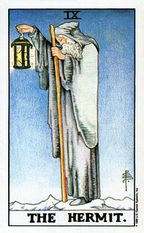
THE HERMIT
Astrological Correspondence: Virgo
Keywords: awakening, enlightening, shedding light, the "key" to a situation, crisis, isolation
Description: The Hermit card symbolises meditation, reflection, and solitude. As one of the cards resembling old age it also represents bearing the light of wisdom, looking into the unconscious, observing dreams. There is an emphasis on peace and patience, by which maturity is reached, and a striving to connect to the higher spiritual self. The Hermit also depicts the spiritual leader, the taskmaster who leads with purpose, conscience, and wisdom. A mature person, the Hermit symbolises deliberation about which path to follow, reassessment of achievements and goals, and taking the time to reflect and plan.
In a negative environment this card can resemble excessive isolation, lack of communication, intolerance, crisis and doubt.
CARD 2 - ABOVE
Present and Future thoughts - What the client thinks could be the Outcome.

(V) THE 5 of WANDS
Astrological correspondences: Saturn in Leo
Keywords: conflict and chaos, arguments and verbal battles, tension, strain, delays and difficulties
Description: The Five of Wands indicates that events beyond our own control are working at cross-purposes to cause delays, difficulties, and tensions. It may well appear that the persons involved believe they have the situation under control, but forces outside of their sphere of influence are actually calling the shots.
Saturn in Leo
If you have Saturn in Leo, you possess diplomatic, organising, executive, and leadership ability along with a strong will. You tend to be self-reliant, conservative, and are extremely efficient. You may have difficulty expressing your emotions and your affections, which may make you appear cold and unloving. You need love, but may not know how to go about giving or receiving it, thus you may isolate yourself from others. Your love is motivated by strong feelings of duty and responsibility and you show your love by taking care of business and doing what is required or by giving material things to loved ones instead of yourself, which is what they really want.
On the negative side, you may be cruel and quick-tempered, jealous, and may resort to underhanded means to satisfy your ambitions. Heart trouble is possible with this position. You need to be admired for your ability to get things done efficiently and effectively.
CARD 3 - BELOW
Present and Past manifestations - What was happening and still is. Physical.

(V) THE 5 of CUPS
Astrological Correspondence: Mars in Scorpio
Keywords: sorrow, disappointment, unhappy.
Description: Five of Cups is a melancholy card. The person in question has been disappointed in some way and is therefore a little depressed. The depression is not as great as that of The Moon, but he or she is nevertheless unhappy. Even though they feel let down, they will be able to learn to help build upon a better future. Loss of a relationship, sorrow, emotional hurt and feeling of worthlessness. However, although the card seems to be grim, the outlook is good and urges you to stop crying over spilt milk and look in another direction for happiness.
Mars in Scorpio
If you have Mars in Scorpio, you are extremely strong-willed and you pursue your goals and desires with passionate dedication and determination. You are capable of total concentration and tremendous discipline, and you are very difficult to influence once your mind is made up. When you want something, you can be very one-sided and almost obsessed with it. You tend to be secretive and you do not want others to know what your plans are. You tend to be instinctive, perceptive, determined, strong-willed, stubborn and magnetic. You have deep emotions and may occasionally show a primitive side. You need to learn self-discipline or your desired nature will rule your life, probably causing great sorrow in the end. You must learn to control your jealousy and possessiveness in matters of love. A certain amount of detachment in relationships would probably be good and this, of course, would include your tendency to treat loved ones as possessions. You are very forceful in a quiet and subtle way and others may have difficulty in seeing or understanding your motives. You can manipulate people in a way that is not obvious to them or others. Direct confrontation with others is not your preferred style. You like operating behind the scenes. In any case, you are a formidable opponent when riled. In matters of health, there may be a tendency towards haemorrhoids.
CARD 4 - LEFT
Past and Present thoughts - What the client has already experienced.

(V) THE 5 of COINS
Astrological Correspondence: Mercury in Taurus
Keywords: down and out, poor, desolate, bad news, very negative.
Description: The Five of Coins indicates that the affluent lifestyle we have lived cannot continue. A sense of depression or unhappiness will tend to prevail. Things may start to improve, but that depends on the other cards in the spread and their placement in relation to the five of coins itself.
Mercury in Taurus
If you have Mercury in Taurus, your manner of thought and speech is slow and quite deliberate. You do not change your mind quickly and see no reason to do so. You are determined, practical, methodical, and conservative in most things you do. You have patience and the ability to stick with things until the end. You may assimilate material at a slower pace than others, but once a concept is learned, it is never forgotten. You hate being forced or rushed into a decision or an action, especially if you have not been time to think it all through and evaluate the practicalities of the situation. Once your mind is made up, that's it. It will take a lot to undo it. Perseverance is one of your best traits. You enjoy sustaining what others have started, especially if you can see tangible, practical results. You love to build things. You succeed not so much because of your mental brilliance, but because you have the ability to concentrate and follow a project through to its completion. You may have an artistic or musical aptitude. Perhaps you sing or speak for a living. Common sense is not uncommon in you.
CARD 5 - RIGHT
Present and Future manifestations - What is to come, unless changed by the client.

(X) 10 of SWORDS
Astrological Correspondence: Sun & Moon in Gemini
Keywords: ruin, betrayal, loss.
Description: The Ten of Swords is the card of ultimate betrayal. This card indicates that hope for outcomes are not likely to transpire and a sense of loss will come. When this card is the answer to a question relating to a partnership, it is best to have only minimal dealings with the person referred to because, at best, disappointment is likely to be the outcome of this liaison. This is the worst card in the pack. Lost, cold and loveless this card shows the lowest point in fortune. However, since this is the worst it can only get better, improvements must surely follow. The only way from here is up.
Sun & Moon in Gemini
Sun in Gemini natives are friendly, clever, talkative, versatile, curious, perceptive, intuitive, and logical. At times, they can also be quite contradictory, restless, two-faced, critical, and impatient. Gemini people enjoy and need work that includes a great deal of variety. They love to do several things all at the same time, sometimes making them late for appointments. They abhor boredom. Gemini natives tend to flit from one experience to another, gathering in all types of information along the way, but seldom getting to the depth of any subject. They go broad and not deep. Persistence is not their strong suit. Gaining knowledge and disseminating it is their real talent. Hence, they make wonderful salespeople or teachers if they stick around long enough to get all the facts instead of only half the story. Even if they do not possess all the facts, since they are never at a loss for words, they will continue with their story as if they did have all the facts.
It is important for Gemini natives to seek intellectual satisfaction. Mental stagnation turns them off, so they read extensively and communicate widely in order to satisfy this longing for mental stimulation. This discontent can make them either very ambitious, or it can incline them to jump from one thing to another, searching for the greener grass which never appears.
Gemini natives usually think quickly on their feet and have the ability to use the right words in any situation. They possess tremendous wit and a good sense of humour. Other people may have difficulty in keeping up with their rapid change of subjects.
Because Gemini natives think so quickly, they often finish other people's sentences for them. This can be most frustrating for the person trying to express their own thoughts. There is a need to learn how to control the tongue and allow slower people to express their own opinions and ideas.
Since Gemini natives have the capacity to see both sides of any issue, they may fluctuate back and forth between opposing viewpoints. They will usually tend to side with the opinion of whomever they happen to be with at the moment. Then they change as the circumstances change. Indecisiveness is a problem for Gemini natives.
Gemini natives are usually emotionally detached. They use their minds rather than their hearts to find their way through things. Logic and reason are their guidelines. They are able to understand what makes other people behave as they do, but they have difficulty in projecting themselves into the emotional reactions of the person involved.
Some of the negative traits that Gemini natives possess are lack of concentration and focus, undependability, fickleness, indecisiveness, superficiality, wishful thinking, and dreaminess. They can also be pretty good at nagging.
Gemini natives need to work on getting their mind under control. Their nervous system is highly strung. If they don't learn to control their nerves, they are apt to become ill. The way out of this difficulty is to take the emphasis off themselves and lose it through service to others. Above all, the Gemini needs to learn to channel (control) their energy and mind.
If you have the Moon in Gemini, you tend to intellectualise your feelings. Your moods come through your words. At times you are totally unaware of your own or other people' deeper feelings and emotional needs. You talk about your feelings and moods. Your primary need is to communicate and to share knowledge. You tend to avoid heavy, emotional relationships and involvements because there is some tendency to superficiality. Commitment scares you. You require plenty of mental stimulation and you feel closest to people with whom you can share thoughts and mental interests. You get turned on sexually through the mental side of things. You have a versatile and receptive mind with a great desire for knowledge. You can be charming, witty and warm-hearted. Nervous tension, anxiety, and stress may be a problem for you. You probably dislike arguments and have a tendency to talk too much. You may tell people what they want to hear rather than the truth. Mental control should be developed or else indecisiveness and constant changing of your mind will become a way of life for you.
History, Astrology, Tarot, and the Human Future
Human beings have always tried to understand the future by first learning how to read the past. Before there were data models, political forecasting, or climate simulations, there were chronicles, omens, star-maps, sacred texts, and symbolic systems meant to reveal the hidden pattern behind events. The impulse behind all of them is the same: history does not feel random when one is living through it. It feels charged, meaningful, cyclical, and at times uncannily repetitive. We watch civilizations rise, harden, flourish, overreach, fracture, and attempt renewal; we watch generations repeat inherited errors in new language; and we are left with the suspicion that if we could only understand the deeper pattern, then perhaps we might gain some warning about what is coming next. That is where the combined use of history, astrology, and Tarot becomes so compelling. None of these, taken alone, can offer certainty about the future of the human race. But together they create a symbolic and interpretive framework through which societies can think more deeply about civilizational change, moral drift, crisis, and possibility.The central idea developed across this discussion is that the future is not best understood as a line of fixed predictions. It is better understood as a field of pressures, tendencies, thresholds, and consequences. History provides the record of how such pressures have appeared before. Astrology provides a language for historical atmosphere, collective timing, and the recurrence of symbolic conditions. Tarot provides a compact dramatic structure through which civilizational states can be interpreted as living moral and psychological patterns. When these three are brought together, they do not eliminate uncertainty; rather, they discipline imagination. They help us ask better questions about what kind of age we are entering, what sort of leadership it requires, and what errors of consciousness make decline more likely.
One of the earliest motifs in this broader reflection was the dream-image of the year 2088: a world covered by a dark pink dust cloud, the sky blocked out, men and women ragged and masked with cloth moving slowly in search of food and water, and a solitary figure carrying a light in one hand and a staff in the other. Again and again, a small diary is taken from a back pocket. It bears the words Diary for 2088, but every page is blank. On the surface, this dream could be interpreted literally, as a warning of environmental collapse, atmospheric disaster, and social breakdown. Yet the deeper reading that emerged is more profound. The dream may symbolize not just the climate of weather, but the climate of civilization: a world in which continuity has been broken, the horizon obscured, public life depersonalized, and the inherited story of society no longer capable of writing itself forward.
This symbolic reading matters because it shows how historical research and symbolic interpretation can strengthen one another. History tells us that civilizations do not usually collapse all at once from a single cause. They weaken through converging pressures: moral exhaustion, institutional rigidity, economic strain, elite detachment, social fragmentation, loss of common meaning, and environmental stress. What a dream or symbolic system like Tarot can do is condense these diffuse pressures into images powerful enough to be felt. The dust cloud becomes the obscuring atmosphere of confusion and fear. The ragged crowds become the movement of dispossessed and uncertain masses. The hidden faces become mistrust, depersonalization, and the decline of civic recognition. The blank diary becomes interrupted continuity: the sense that the future exists, but the old language for writing it has failed. Such symbolism does not replace historical analysis. It intensifies it by revealing its moral and psychological dimensions.
Tarot proved especially useful in organizing these themes. The first spread centered on The Hermit, chosen because the year 2088 reduces numerologically to 9. Around it stood the 5 of Wands, 5 of Cups, 5 of Coins, and 10 of Swords. Taken together, these cards described not merely a bad political phase, but a civilization under stress on every level. The 5 of Wands suggested conflict, contest, and the breakdown of easy consensus. The 5 of Cups emphasized grief, regret, and the recognition that losses have already occurred. The 5 of Coins pointed to material insecurity, exclusion, and the breakdown of presumed comfort. The 10 of Swords brought the image of a story that has reached an unsustainable end. At the center stood The Hermit, old and solitary, carrying a lamp through darkness. This spread captured a specific civilizational mood: a Europe, and perhaps a wider Western order, rich in memory and moral vocabulary, but increasingly isolated, strained, and uncertain of its own authority.
This Tarot framework led naturally into a literary reinterpretation. In that essay, Europe appeared as an old house under deepening weather. Its beams still stood, but they groaned. Its keepers still spoke, but their words no longer had the same binding force. Outside, the atmosphere had changed; inside, memory alone could not sustain the walls. This metaphor is historically important because it reflects one of the chief lessons that research into past civilizations reveals: old orders rarely fall only because enemies batter them down. More often, they begin to fail because their internal narratives, institutions, and moral assumptions no longer match the conditions around them. The literary image of the blank diary was especially important here. It suggested that the future of civilization is not simply erased, but unwritten because inherited continuity has been interrupted. That interruption may be catastrophic, but it may also be a severe form of freedom. If the pages are blank, it means the old script no longer governs. A new one must be earned.
The inquiry then moved to a revised Tarot spread for 2025–2035, where the cards shifted to Justice, 7 of Wands, The Moon, 6 of Pentacles, and Death. This was a crucial development because it repositioned the coming decade not as total ruin, but as reckoning under pressure. Justice at the center suggested accountability, legal and political consequences, and the balancing of realities long obscured by rhetoric. The 7 of Wands indicated a defensive posture, a civilization increasingly imagining itself not in terms of expansion or moral confidence, but in terms of holding ground. The Moon beneath the spread suggested that all of this unfolds under conditions of uncertainty, fear, unstable narratives, and the inability to distinguish clearly between genuine danger and projection. The 6 of Pentacles pointed back to the older social order of welfare, redistribution, aid, and moral obligation—a system of managed support now under strain. Death on the right did not signal annihilation, but irreversible transformation: the end of one political and civilizational script, whether or not those living through it are ready to admit it.
The significance of this spread, viewed through history, is that it captures a recurrent moment in civilizations entering a threshold period. Historical research shows that societies often live for long periods through inherited legitimacy—through systems built by earlier generations that continue to distribute order and meaning even after their creative energy has waned. Eventually, however, these systems face what Justice represents: reckoning. Resources, borders, loyalties, institutions, and legal principles must be measured against realities they were not originally designed to handle. Under such conditions, defensive politics often intensify; public perception becomes unstable; and support systems that once seemed expressions of civilized confidence begin to look fragile or overextended. The Tarot spread, then, is not a magical prediction of exact events. It is a symbolic dramatization of historically recognizable pressures.
Astrology added another layer by focusing on Saturn–Neptune in Aries. In this framework, astrology was not treated as a device for deterministic prophecy, but as a language of historical atmosphere. Saturn signifies structure, discipline, law, burden, limit, and consequence. Neptune signifies dream, illusion, mass feeling, spiritual longing, confusion, and dissolution. Aries signifies assertion, conflict, beginnings, identity, frontier, and the impulse toward action. A Saturn–Neptune conjunction in Aries therefore symbolizes a time when blurred ideals collide with hard limits in a context of urgency. It is the point at which a civilization can no longer sustain the gap between what it imagines and what it can actually maintain. The dream of seamless management, open-ended aspiration, or indefinite moral abstraction meets the harder questions of sovereignty, borders, survival, and decisive action.
This astrological symbolism illuminated the earlier dream and Tarot material with remarkable coherence. The darkened sky became Neptunian obscurity under Saturnine pressure. The ragged crowds became Neptune’s masses marked by Saturn’s hardship. The search for food and water became the reduction of politics to elemental needs under an Aries atmosphere of emergency. The solitary lamp-bearing figure became a fusion of Saturn’s staff, Neptune’s light, and Aries’s necessity of forward movement. Most importantly, the blank diary became a Saturn–Neptune image of time itself: chronology and continuity emptied out, awaiting a new beginning that cannot emerge peacefully from the old script. Here the value of combining astrology with history becomes clear. Astrology does not tell us “what event will happen on what day” in any scientifically verifiable sense. What it can do is offer a symbolic map of what sort of historical texture is likely to dominate a period: pressure rather than ease, confrontation rather than mediation, disillusionment rather than optimism, hard redefinition rather than drift.
Among all the symbols used in this reflection, The Hermit remained one of the most important. As a civilizational archetype, The Hermit represents wisdom, conscience, memory, and the lonely task of carrying a light through darkness. In a positive form, he is precisely what humanity needs in periods of obscurity: not charisma, not intoxication, but orientation. Yet the inquiry also expanded on the shadow side of The Hermit, and this is where the interpretive framework became most politically and morally serious. The Hermit’s shadow is detachment from ordinary life, wisdom without vitality, over-reflection leading to paralysis, moral superiority, withdrawal disguised as prudence, and, in its darkest form, the custodianship of decline. A civilization ruled by the shadow Hermit may diagnose its crisis eloquently, preserve rituals of legitimacy, and continue speaking in elevated moral terms while losing the will, clarity, and practical force necessary to respond to actual pressures. This is one of the great inadequacies of humanity in the modern age: not a lack of information, but a recurring inability to transform knowledge into timely and proportionate action.
This brings us to the final and largest issue: what does all of this reveal about the future of the human race and its inadequacies? The answer is not that astrology and Tarot can mechanically predict the destiny of humanity. Rather, they reveal the recurrent weaknesses through which humanity sabotages its own future. History shows these inadequacies repeatedly. Human beings confuse prosperity with permanence. They inherit systems they did not build and assume those systems will continue to function indefinitely. They cling to moral languages after the social substance that once made those languages effective has eroded. Elites drift away from the lived reality of ordinary people. Institutions become elaborate but brittle. Compassion loses relation to capacity. Law loses relation to trust. Public life becomes saturated with fear, projection, and unreality. In symbolic terms, the sky darkens, faces disappear behind coverings, and the diary of the future remains unwritten.
Yet these same systems of interpretation also reveal possibility. Tarot is never only fatalistic. Even harsh cards contain a seed of transformation. Death means an ending, but one that makes renewal possible. Justice means reckoning, but also correction. The Moon means confusion, but also the demand for deeper intuition and honesty. The Hermit may become detached, but he may also carry the only true lamp left in an age of distortion. Astrology too, when used responsibly, is not merely ominous. Saturn can become discipline rather than oppression. Neptune can become vision rather than delusion. Aries can become courage rather than violence. The future of the human race, viewed through these symbolic traditions, is therefore not fixed in doom. It is contingent on whether humanity can overcome its characteristic inadequacies: denial, passivity, abstraction, moral vanity, refusal of limit, and inability to act before crisis becomes ruin.
The full impact of researching history, then, is not merely academic. It reveals that many of the pressures we experience as uniquely modern are in fact recurring features of civilizational life. What astrology and Tarot add is a symbolic grammar for understanding how those pressures feel, how they gather, and what archetypal forms they take when they enter public consciousness. History gives evidence; astrology gives atmosphere; Tarot gives drama and moral structure. Together they cannot prove the future, but they can illuminate its possibilities with unusual depth. They can show that the greatest threats to the human race are not only technological or environmental, but spiritual and civilizational: the loss of clarity, the weakening of meaningful boundaries, the failure of leadership, the breakdown of reciprocity, and the temptation to preserve appearances rather than renew substance.
In the end, the image that remains is still the most powerful one: the solitary figure carrying a lamp and a staff under a darkened sky, while the diary of the future lies blank in his pocket. That image contains the whole argument. Humanity does not possess the future in advance. It carries only fragments of light, memory, and endurance into a world whose next pages have not yet been written. Researching history teaches us how often civilizations have reached such thresholds. Astrology and Tarot suggest the quality of the threshold now before us. And all three together imply the same conclusion: the future of the human race depends not on whether we can eliminate uncertainty, but on whether we can meet uncertainty with enough truth, courage, imagination, and discipline to deserve a future at all.


1 comment:
After much research, I have checked this reading and found that the timing of this dream just gave me the narrative at that moment in time and so it played on my mind for a few years until I realised that my assumptions were possibly wrong, and so decided to do some researching using history, Astrology and Tarot to understand the dream in its entirety.
Post a Comment